



the scientist first A signal was recorded in the radio range that was directly related to the exoplanet rather than its star. The signal was detected in Beta Pictoris b, a gas giant planet in the star system of the same name, approximately 63.4 light-years away from Earth. Astronomers have detected similar radio emissions in exoplanet systems before, but this is the first time they have been able to definitively link the radio signals to another planet.

Image source: AI Generation Grok/3DNews
The observations were made by the MeerKAT radio interferometer in South Africa during four sessions in 2025-2026. The researchers detected two components of the emission: a constant radio emission and a brief, repeating burst of highly circular polarization. Signals were observed in the frequency range 0.85 to 3.5 GHz. This combination of features shows a mechanism related to the planet’s magnetosphere: charged particles interact with the magnetic field, accelerate and produce electromagnetic radiation, while forming auroras. It is a similar process that is observed in the planets of the solar system. The most striking example is the powerful radio emissions from Jupiter’s magnetosphere.
The most important result of this work is the ability to link radio emissions directly to Beta Pictoris b, one of three planets discovered in this system. This is due to MeerKAT’s relatively high spatial resolution and repetitive burst nature. According to researchers, the planet’s magnetic field may be very strong – thousands of times stronger than Earth’s. Apparently this is caused by the planet’s rapid rotation around its axis – it completes one revolution in 8 to 9 hours. Scientists noted that the recorded signals corresponded to model predictions of exoplanets.
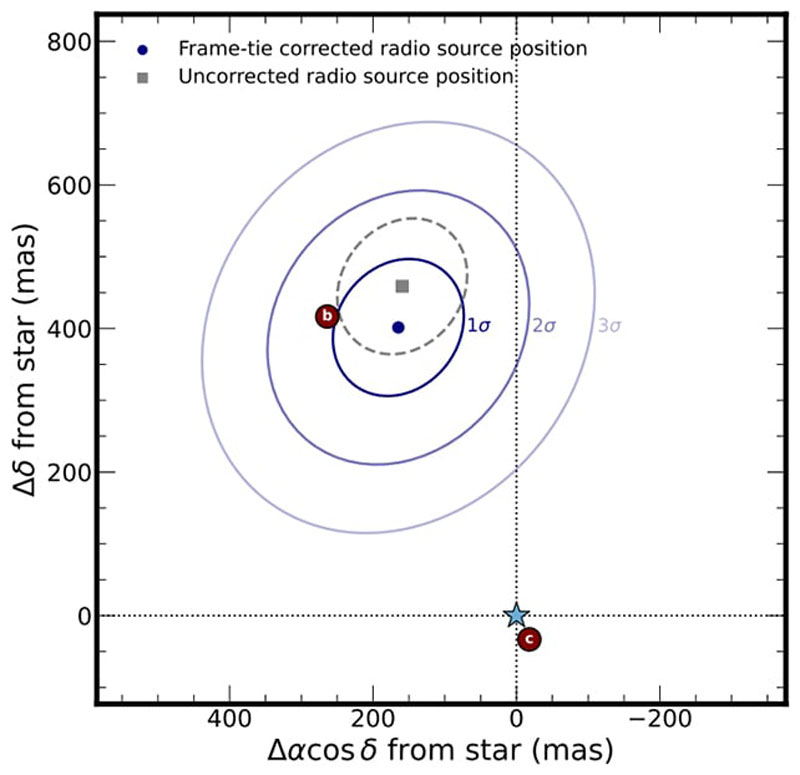
Image source: arXiv 2026
The discovery is important not only in its own right: radio astronomy is getting a new way to study the magnetic fields of exoplanets. The magnetosphere protects a planet’s atmosphere from the flow of charged particles from the star, so its presence is thought to be one of the factors potentially affecting the preservation of the atmosphere of rocky worlds. However, Beta Eastor b is a large gas giant with a mass 10 times that of Jupiter, and is definitely not a candidate for finding life on it. Therefore, no matter how much we wish, the detected signals cannot be regarded as messages from alien civilizations.
If you find an error, select it with your mouse and press CTRL+ENTER.